

A progressive change in the follicle
Androgenetic alopecia involves gradual miniaturisation of certain follicles: individual hairs become finer and coverage decreases. Susceptibility is partly genetic. Androgens, including dihydrotestosterone, play an important role in male-pattern hair loss; the mechanisms of female-pattern hair loss are more complex. The diagnosis alone does not mean that hormone levels are abnormally high.
Patterns in women and men
In men, thinning often involves the temples and crown. In women, it may appear as a widening part or reduced density over the top of the scalp. Patterns vary and another cause of shedding can coexist. These descriptions are information only; they do not allow a diagnosis based on a website image.
What the consultation assesses
The discussion considers onset, progression, family history, medicines and previous treatments. Scalp examination, sometimes supported by dermoscopy or trichoscopy, looks for miniaturisation and signs of other conditions. Blood tests or other investigations are considered when useful; hormone testing is not automatic. The personal impact of hair loss is also part of the assessment.
Dutasteride: targeting DHT production
Dutasteride is a potent inhibitor of both type I and type II 5-alpha-reductase. This enzyme helps convert testosterone into dihydrotestosterone (DHT), which is involved in miniaturisation of susceptible follicles. It therefore affects DHT production rather than directly blocking its receptor. The mechanism alone does not predict the outcome of topical application or a particular combined treatment.
Care offered at the practice: microneedling and Dutexome
Following a hair assessment, Dr Sami Hamwi may offer scalp microneedling with topical application of c.prof 231 Dutexome Solution. The manufacturer describes a formulation containing 0.05% dutasteride, plant-derived exosomes, copper tripeptide, biotin and B vitamins. Microneedling creates small skin channels; it is not a hair transplant. Suitability, timing and its role within your overall treatment are discussed individually. Depending on the assessment, a course of six sessions approximately one month apart may be proposed, with review of tolerability and progress. Timing and any associated treatments are individualised.
Before / after
Projection of a course of six sessions approximately one month apart, combining microneedling and topical Dutexome. Goals and progress are reviewed with the dermatologist.
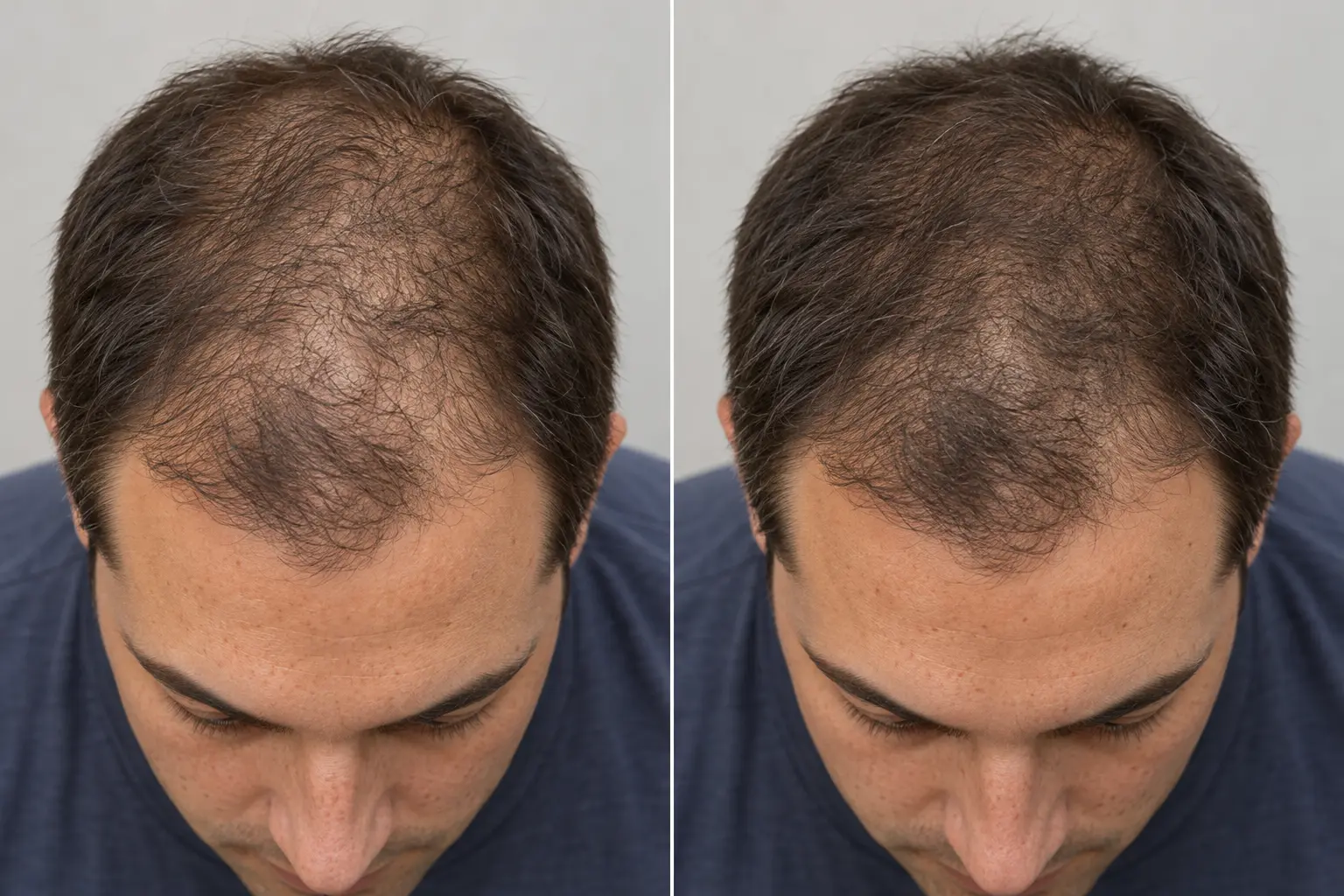
These comparisons illustrate possible changes; they do not document treated patients. Actual outcomes and the number of sessions vary.
Possible benefits, alternatives and evidence
The aim is to plan care around the cause of hair loss and the remaining follicles. Topical minoxidil, selected prescription treatments, observation or a discussion of transplantation may also be appropriate. Studies have examined microneedling with dutasteride or exosomes, but products and protocols differ: their findings do not automatically validate every combination, including Dutexome with a specific device. Benefit varies and no regrowth or precise density can be guaranteed.
Recovery and precautions
Tenderness, redness, pinpoint bleeding or temporary swelling may follow microneedling. Irritation, allergy and infection are risks to discuss. Local application does not exclude systemic exposure to dutasteride or guarantee freedom from adverse effects. Mention your medicines, history, sexual or mood symptoms, and pregnancy plans. This procedure is not offered during pregnancy or breastfeeding; precautions concerning conception and contraception are reviewed in consultation. Do not change prescribed treatment without medical advice.
Transplantation and monitoring over time
A transplant redistributes follicles and does not necessarily stop changes in non-transplanted hair. Suitability considers the donor area, progression and overall care plan. With or without transplantation, progress is reviewed over months using examination and comparable photographs when useful. Stabilisation can itself be a meaningful aim; complete regrowth is not guaranteed.
Preparing for the first appointment
If you do not have an established diagnosis, choose a medical dermatology consultation. Bring the names and durations of previous treatments, existing reports and any earlier photographs you wish to show the doctor. Sudden onset, patches, pain or scalp inflammation should be mentioned during clinical care. The website form remains administrative only and cannot assess these signs.
Your questions
Can I book an appointment to discuss this procedure?
Start with a hair assessment with Dr Hamwi. Examination helps establish the cause, assess suitability and discuss alternatives before any sessions are scheduled.
Is it always a matter of testosterone levels?
No. Follicular sensitivity, genetics and other mechanisms are involved. A hormone result alone does not establish the diagnosis; investigations depend on examination and context.
Can all lost density be restored?
Benefit depends on the individual situation and treatment. Goals may include slowing progression or improving some density. An individual result cannot be guaranteed.
When can progress be reviewed?
Assessment takes place over several months, depending on treatment and the hair cycle. Timing and review criteria are agreed with your doctor.
Should I start by booking a hair procedure?
No. Medical assessment and diagnosis come before choosing a procedure. This website does not select a protocol for you.
References and further reading
- British Association of Dermatologists · Male pattern hair loss (new tab)
- British Association of Dermatologists · Female pattern hair loss (new tab)
- Kaiser et al. · Treatment of androgenetic alopecia (2023) (new tab)
- EMA · Finasteride and dutasteride: safety review (new tab)
- Dhurat et al. · Microneedling in androgenetic alopecia: pilot trial (2013) (new tab)
- Mesoestetic · c.prof 231 Dutexome · composition fabricant (new tab)
- Mesoestetic · Dutexome · information et consentement fabricant (2024) (new tab)
- EMA · Dutasteride · mechanism of action (new tab)
- Sánchez-Meza et al. · Microneedling plus topical dutasteride (2022) (new tab)
- A prospective study of exosome therapy for androgenetic alopecia (2025) (new tab)
Manufacturer instructions describe a product; they do not guarantee clinical results. Information on this website does not replace a consultation.
